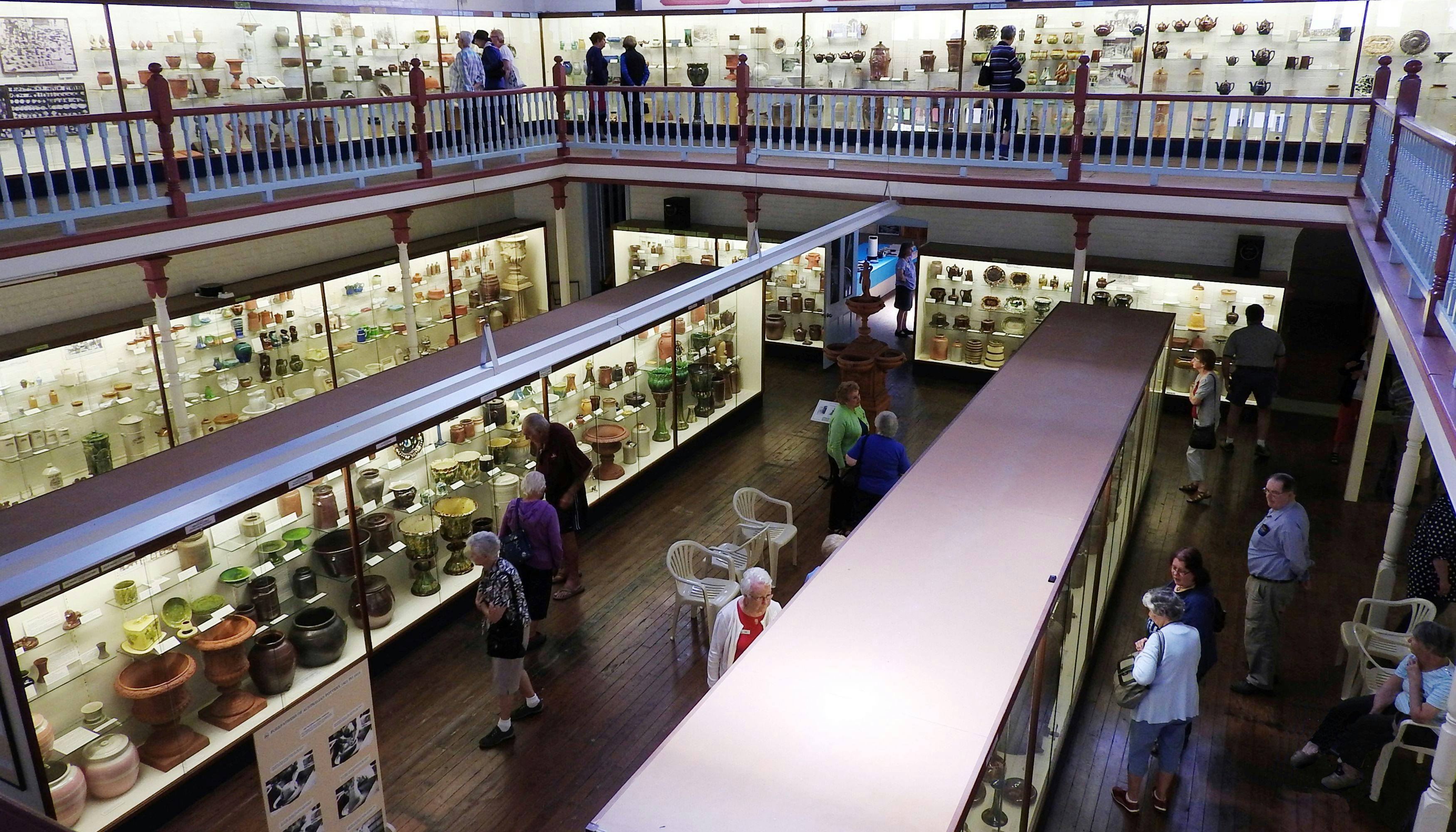
The Geoff and Kerrie Ford Australian Pottery Collection is devoted to potters and potteries established between 1788 and 1920, and includes pieces from those who continued after 1920 until they closed.
Recent acquisition
1888 Melbourne Centennial Exhibition Vase.
This 50cm tall Magnificent Majolica glazed hollow Exhibition Vase was made by Luke Nolan and formed part of his exhibit at the 1888 Melbourne Centennial Exhibition.
It is hand decorated with a face mask of Neptune with a stylised Dolphin on each side, front and back, along with a well-presented variety of foliage decoration, on both sides. The pumpkin style decoration around the top and the glaze colour is identical to the Jardiniere in the collection, that is impressed: ‘LUKE NOLAN GILLBROOK POTTERY BRUNSWICK.ʼ

A report on the Exhibition published in October 1888 states: ‘On the opposite side of the stand, facing the Victorian Ladies Court, are specimens of the smaller work turned out by one of the largest exhibitors Mr. Luke Nolan of the Gillbrook Pottery, Brunswick, including both the ornamental and the useful. In the former division attention will be given chiefly to a very beautiful vase of pure Etruscan pattern by far and away the best thing of the kind on the stand. The shape of the vase is delicate, the lines light, sharp and clear, the flower scroll effective, which has been used with just the right decree of economy, gracefully bestowed. Coming down to smaller vases, and such familiar and homely articles as jugs and tea-pots, those interested in the industry will find them in Rockingham, Chesterfield, Cane ware and Majolica ware.ʼ
After the exhibition closed a newspaper notice in February 1889 announced: ‘CENTENNIAL EXHIBITION. MILES and BARRY will sell by auction, under instructions from the manufacturer, L. Nolan. Esq., Gillbrook Pottery Brunswick. All his exhibits, Consisting of SPLENDID VASES, URNS, JUGS, JARDINIERES, CARAFES, &c., &c. All these Exhibits Obtained FIRST CLASS AWARDS And SPECIAL COMMENDATION. The collection comprises most unique specimens of the potter's art, rivalling the finest porcelain in the beauty of their modelling. Entirely without reserve. Terms- cash on fall of hammer.’
A very similar vase in terracotta, can be seen on display in the 1899 photograph of Luke Nolan's exhibit in the Brunswick Town Hall.
A remarkable survivor from the 1888 Melbourne Centennial Exhibition, so far, the only known piece.
---------------------------------------------------------------------------------
THE JONATHAN LEAK 1823 VICTORY COMMEMORATIVE WINE JUG
This 200-year-old 20cm high wheel thrown, salt glazed stoneware unique commemorative Jug is adorned with fine coggle decorations, applied Prince of Wales plumes and Neo-classical motifs – a press-moulded handle and spout featuring a facemask of Bacchus (The God of Wine), embossed with two panels of classically draped women dancing at a Bacchanalian festival, one playing a triangle and the other sacrificing a hare to Bacchus, framed by applied acanthus leaves.
Moulds taken from both sides of an ‘Arthur Duke of Wellingtonʼ medallion, struck in 1820 to commemorate his victory at the battle of Vittoria, Spain on the 21st of June 1813 against the French during the Napoleonic Wars, have been applied to the jug surface.
The Vittoria medal, one in a set of 40, was brought to Australia in July 1822 by James Mudie (1779 - 1852) who gifted a complete set of his medals in gilt bronze to Sir Thomas Brisbane, the sixth Governor of New South Wales. All the medals depicting important military and naval events were struck in England, to commemorate British victories over the French spanning a 20 year period, from 1797 to 1817. The set was housed in a leather case inscribed on the cover: ‘Presented to His Excellency Sir Thomas Brisbane, K.C.B., by J. Mudie.’
Brisbane, who took part in the battle, had Jonathan Leak commissioned to produce the jug to celebrate the upcoming 10th anniversary of the victory.
The jug is impressed on the base: ‘J. LEAK’ and has a very smooth and even wear mark around the base that shows it has been well used and looked after over a long period of time.

Jonathan Leak (1777-1838) a trained Staffordshire potter was tried and convicted of burglary in March 1819. Two weeks later his death sentence was commuted to transportation to Australia for life. On arrival in December 1819, he was put to work at the Government Pottery on Brickfield Hill, Sydney.
In December 1821, now with the patronage of the Governor, Leak was permitted to start working for himself, on the condition he pay the Government a quarterly fee of £2 5s 6d, ($4-55).
In May 1822, Leak's wife Mary and four of ther children arrived to join him as free settlers and Leak began establishing his own pottery works on land off Elizabeth Street, near the Brickfields.
In September 1822, because of his good conduct and diligent application to work, Leak was granted a ticket-of-leave and assigned to himself.
By July 1823, after nineteen months hard work, part of which was producing this jug, Leak had proven the worth of his pottery business and obtained a land grant on his chosen site off Elizabeth Street.
In 1828 Leak received a conditional pardon and by 1833, with the help of his wife, their children, and 20 free men, Leak's Pottery was producing a range of lead glazed domestic earthenware and salt glazed stoneware bottles, jars, jugs, tiles, bricks, and smoking pipes. Leak's pottery business continued to do well but came to a halt soon after his death in December 1838.
The jug's history remains a mystery until it was discovered in the 1930s, by a Tasmanian couple who had a deep interest in military artefacts.
Initially mistaken as British manufacture from one of the Staffordshire potteries, with an obscure maker's mark 'J. LEAK' impressed on the base, it was amongst a variety of early English and European pieces that they exhibited alongside several other prominent Tasmanian collectors who all lent treasured items for display at an Antique and Historical Exhibition held in the Hobart City Hall in June 1945, in aid of the Red Cross Society.
Following the couple's passing in the mid-1980s, the bulk of their collection was dispersed, however the Leak jug was packed into a cardboard box where it remained for many years, eventually being sold through auction in 2024.
This 1823 Victory Commemorative Wine jug made by Jonathan Leak, whose few surviving pieces are the earliest pottery produced in Australia marked with a potter's stamp, is a key piece in Australian pottery history and is widely regarded as the single most important and historically significant MARKED piece of early Australian convict pottery ever discovered and the most decorative example in existence.
The jug's distinctive design reflects early European influences and holds both aesthetic and historical value in the development of early Australian pottery and offers a glimpse into Australia's colonial past, shedding light on Leak's life and talent, who was known for his craftsmanship and is considered a pioneer of Australian pottery.
We are delighted and proud to have the JONATHAN LEAK 1823 VICTORY COMMEMORATIVE WINE JUG, the pinnacle of our collection, on display in our museum for all to see and appreciate its historical significance.
______________________________________________________________
We are also interested in adding further early Australian pottery pieces to the collection by gift, bequest or purchase.
If you have a piece or pieces you may wish to donate, bequeath or sell please get in touch and send photographs.